
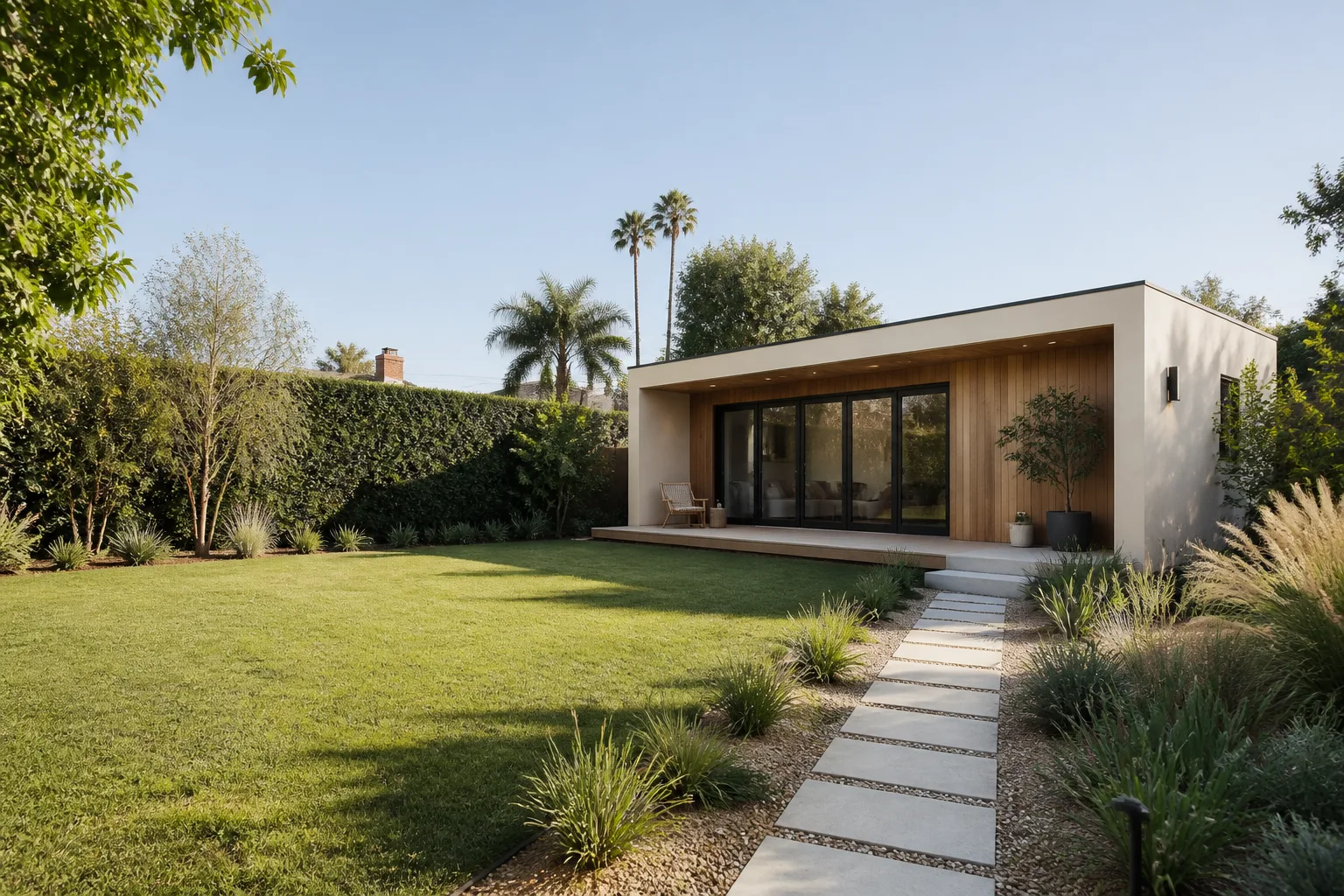
Mighty Buildings Junior ADU Conversion: The San Francisco Owner’s Guide
If your Mighty Buildings junior ADU conversion part has failed or is showing signs of giving out, we stock compatible replacements and install them across San Francisco for a typical range of $450 – $1,400 depending on the specific component and your unit’s series. Most conversions we handle are completed the same day we arrive. The part most owners call us about is the modular wall-to-foundation connection hardware, which takes a beating from San Francisco’s marine air and the constant micro-movement of clay-heavy lots in neighborhoods like the Sunset and Excelsior.
You’ll usually know something’s wrong before it fails completely: a door that suddenly binds at the top corner, a hairline crack running diagonal from a window corner, or a soft spot in the floor where the unit meets the landing. Those are the early warnings we hear about most often from Mighty Buildings owners in San Francisco.
Which Mighty Buildings Models This Applies To
Mighty Buildings has shifted its production focus over the years, but the junior ADU units we service in San Francisco fall into two broad groups: the earlier Mighty Mods series and the later Mighty House units built on the same 3D-printed polymer composite panel system. The connection detail at the marriage line, where the factory-built module sits on your site-built foundation or pad, is the most common failure point on both.
Before you order anything, check the metal ID plate inside the electrical panel door or on the underside of the kitchen sink base. You’re looking for a four-digit series code, usually starting with “MM” or “MH.” That code tells us the exact panel thickness, fastener spacing, and anchor spec your unit was built to. One compatibility catch: the earlier Mighty Mods used a 12 mm composite floor cassette with embedded steel channels, while later Mighty House units switched to an 18 mm cassette. The anchor hardware does not interchange between the two. We stock both, but we won’t know which you need until we see that code or take a measurement ourselves.
On the OEM versus aftermarket question: for wall-to-foundation hardware and door threshold gaskets, we recommend OEM or OEM-spec parts. The tolerances on the printed panel edges are tight, and a generic anchor plate off the shelf at a big-box store will sit proud of the surface and let moisture in. For more generic items like door hardware and weatherstripping, a quality aftermarket part is usually fine and sometimes better, especially in San Francisco’s salt air, where a stainless aftermarket hinge set will outlast the original zinc-coated hardware by years.
Signs Your Mighty Buildings Junior ADU Conversion Is Failing
- Binding door or window. The unit shifts slightly on its foundation over time, and the first sign is usually a door that rubs at the top corner or a window that suddenly needs two hands to open. This means the anchor system at the marriage line is working loose.
- Diagonal hairline cracks from window or door corners. On Mighty Buildings’ composite panels, surface cracking at corners indicates stress concentration rather than normal settling. San Francisco’s soil expansion and contraction between wet winters and dry summers accelerates this.
- Soft spot in the floor near the entry. If the floor feels spongy where the unit meets the landing or steps, the perimeter seal has likely failed and moisture has been getting to the floor cassette edge. In neighborhoods like the Richmond and Outer Sunset, fog-driven moisture makes this more common than in drier inland parts of the city.
- Visible gap at the base of an exterior wall. You should not be able to see daylight or fit a putty knife between the bottom of the wall panel and the foundation. A growing gap means the anchor hardware has failed or was never seated properly.
- Musty odor that won’t go away. The composite panels themselves don’t absorb water, but the edge seals and threshold gaskets do. Once they fail, moisture wicks into the junction between floor cassette and wall panels, where the smell sets in. This is the one symptom we tell San Francisco owners not to ignore, because the fix gets more involved the longer it sits.
Replacement Cost & What’s Included
In San Francisco, expect to pay $450 – $650 for a single anchor point replacement, $600 – $950 for a full door threshold and gasket rebuild, and $900 – $1,400 for a complete marriage-line re-anchor with new perimeter seal on a junior ADU. The range comes down to access, how many anchor points have failed, and whether we need to remove and reset a section of flooring to reach the hardware.
Every quote from Lodgewick ADU San Francisco is a written price before any work starts, so the number you see is the number you pay. That price includes the parts, the labor, cleanup, and a written guarantee under our 365-Day Done Right Promise. If anything about the repair isn’t right within 365 days, we come back and make it right at no charge. No change orders, no surprise line items when the crew shows up.
- Single anchor point replacement: $450 – $650
- Door threshold and gasket rebuild: $600 – $950
- Full marriage-line re-anchor with perimeter seal: $900 – $1,400
DIY or Call Us?
Some things on a Mighty Buildings unit an owner can handle: tightening a loose hinge, replacing a piece of weatherstripping, adjusting a door strike plate. Those are straightforward, low-risk fixes that don’t require specialized knowledge.
The anchor system at the marriage line is a different story. The fasteners are torqued to a specific spec, and over-tightening them will crack the composite panel edge. Under-tightening means the unit keeps shifting. There’s also a genuine safety issue: if an anchor point has failed and the unit has shifted, the wall panel can be carrying load in a way it wasn’t designed for. Removing the wrong fastener in that situation can cause a panel to move suddenly. We recommend you call us at (707) 760-0502 for any anchor-related issue rather than attempting it yourself. Our technicians are background-checked, uniformed, and have hands-on familiarity with Mighty Buildings panels. We’ll walk the site, find every failing point, and give you a written price before we touch anything.
FAQs
The structural panels themselves have a manufacturer-stated design life measured in decades, but the connection hardware and seals at the marriage line typically need attention every 7 – 12 years in San Francisco’s coastal climate. Marine air and seasonal soil movement wear out anchors and gaskets faster than in drier climates. Call (707) 760-0502 and we’ll assess yours.
It depends on what’s failed. A loose anchor can often be re-torqued in place. A corroded anchor or a compressed, cracked gasket needs replacement. We’ll only replace what actually needs replacing, and the written quote will show the line items.
Most single-point anchor replacements and threshold rebuilds are done in three to five hours. A full marriage-line re-anchor on a junior ADU can take a full day, sometimes two if we’re working around weather. We’ll give you a defined arrival window when you book.
We stock replacement hardware for both the Mighty Mods and Mighty House series on our trucks, plus fittings for other brands we service including Abodu, Cover, and Dvele. If your unit needs a part we don’t have on hand, we’ll source it and schedule the work in one visit once it arrives.
If your Mighty Buildings junior ADU is showing any of these signs, or you just want a professional to look it over before something fails, call us at (707) 760-0502 for a free estimate. Russ Delmar will walk the site himself before any quote is written, and you’ll get a real number on paper before we start. That’s how we do every job in San Francisco.
Written by Russ Delmar, Owner, Lodgewick ADU San Francisco, serving San Francisco and nearby areas.


