
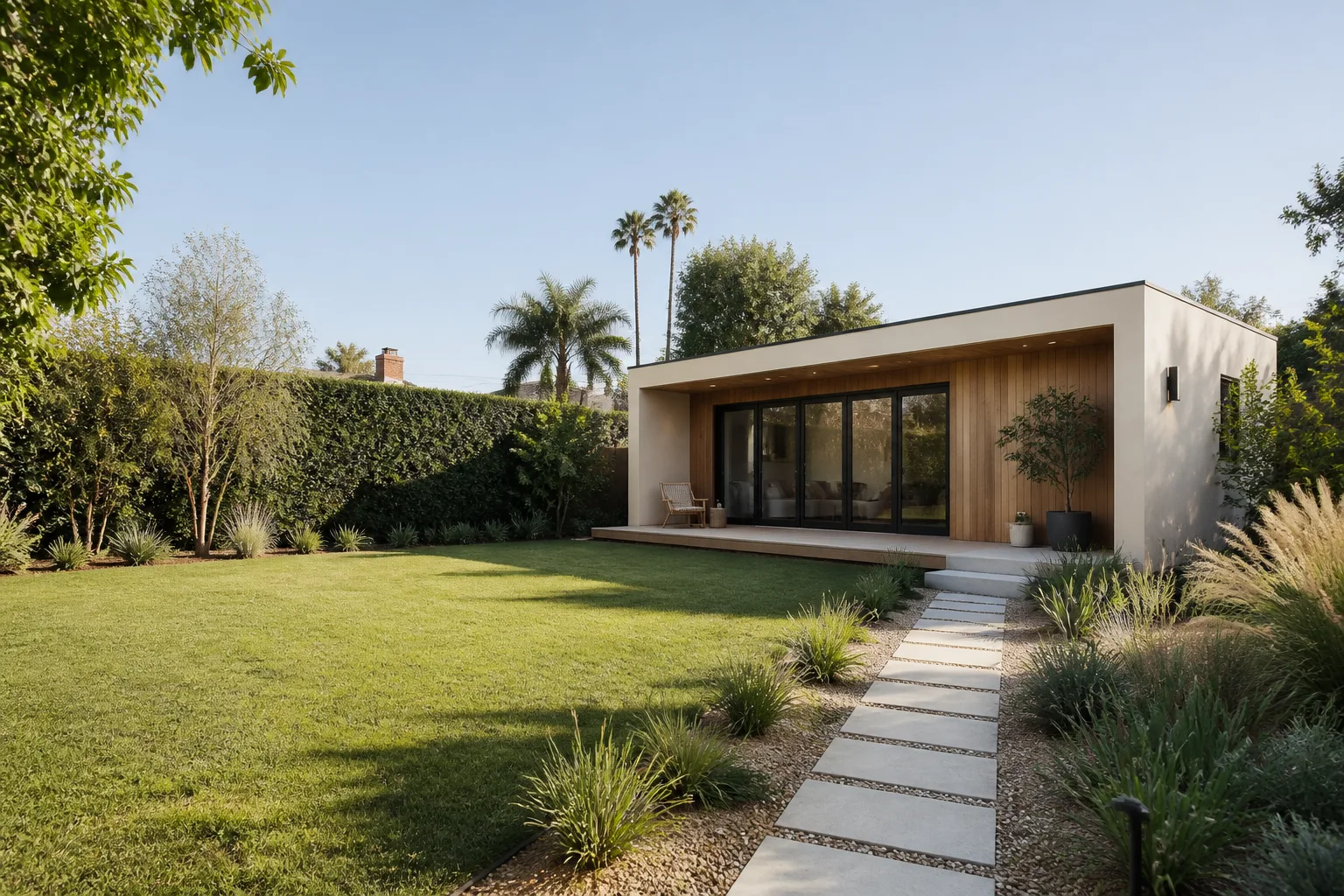
James Hardie New Detached ADU: The San Francisco Owner’s Guide
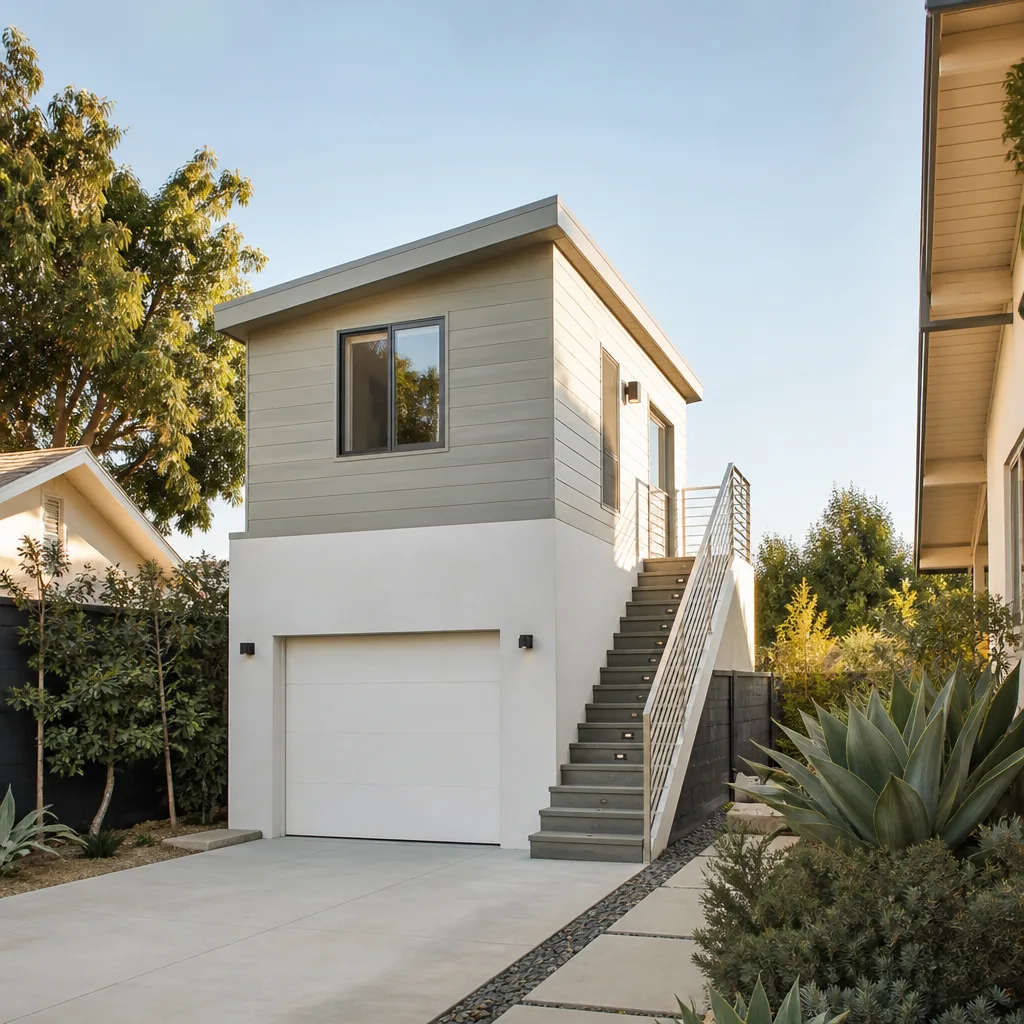
If you’re building or replacing a new detached ADU clad in James Hardie siding in San Francisco, the installed cost typically runs $210 – $390 per 100 square feet for materials and labor, depending on the product line, the condition of the existing wall assembly, and whether you’re in a fog-belt neighborhood like the Sunset or a drier pocket like Noe Valley. We stock HardiePlank lap siding, HardiePanel vertical siding, HardieTrim boards, and the proprietary flashing and fasteners that make these systems hold up in San Francisco’s marine air. Most owners discover they have a failed part after a winter storm, when they spot a cracked board or notice paint peeling along a seam that stayed tight for years.
We’re an independent siding and ADU contractor in San Francisco. We’re not affiliated with James Hardie, but we’ve installed and repaired their products across this city long enough to know exactly which parts fail first and what it costs to make it right.
Which James Hardie Models This Applies To
The parts we’re talking about cover the James Hardie product lines most commonly spec’d on detached ADUs in San Francisco: HardiePlank HZ5 lap siding (5/16″ thick, available in 4×8 and 4×10 sizes for 5″, 6″, 7″, or 8″ exposures), HardiePanel HZ5 vertical siding, HardieTrim HZ10 boards (5/4 and 4/4 thickness), HardieSoffit panels, and the HardieWrap weather barrier often installed behind them. On a detached ADU, the HZ5 rating matters: it’s approved for 120-mph wind load, which is more than enough for any San Francisco lot, including exposed hillside sites in Twin Peaks or Diamond Heights.
Identifying your exact part is the first step. Hardie planks carry a printed code on the back face along the long edge, usually a combination of the plant location, production date, and product designation. On pre-finished ColorPlus product, that code is on the back or the top edge. If the printed code is gone, measure the plank thickness: HZ5 is 5/16″ nominal, which is the most common residential profile on ADUs. Trim boards are thicker, 5/4 or 4/4 nominal, and they’re cut to widths from 4″ to 12″. When we quote a replacement, we always verify the board width and exposure pattern before we order, because an 8.25″ HardiePlank installed at a 7″ exposure leaves a reveal that’s hard to match from memory.
On the OEM versus aftermarket question: James Hardie’s product lines are proprietary cement-fiber composites. There is no true generic equivalent that carries the same 30-year limited non-prorated warranty. What aftermarket suppliers offer are alternative cement-fiber products, like CertainTeed WeatherBoards or Allura, which can work on an ADU but change the warranty profile and sometimes the texture match. If your San Francisco ADU has a seamless elevation facing the street and a weathered elevation in the back, we’ll usually match the OEM product on the street face and give you a frank conversation about the back side.
Signs Your James Hardie New Detached ADU Is Failing
- Corner trim pulling away from the wall plane. HardieTrim boards expand and contract with temperature change, and if they were installed tight to the adjoining plank or caulked solid rather than gapped, the stress cracks the paint seam. On San Francisco ADUs built tight to the property line, this shows up first on the south and west faces, where afternoon sun works the joint hardest.
- A hairline crack running vertically through the face of the plank, usually starting at a fastener. HardiePlank is dense, but it will crack if a nail was overdriven at install or if the plank was forced against a high spot in the framing. We see this most often on small ADUs where the gable-end wall meets the roof, because the framing deflection is greatest there.
- Paint bubbling or peeling in a band along the bottom course. If the bottom plank sits closer than 6″ to grade, splash-back from San Francisco’s wet winters keeps the board damp at the cut edge. Hardie’s warranty excludes wicking at the bottom edge, so this failure is almost always an installation clearance issue, not a product defect.
- Visible swelling or delamination at the cut ends of trim boards. Cut edges are the weak point on any cement-fiber product because the end grain, if you can call it that, is exposed fiber and Portland cement. Trim boards cut on site without end-sealing absorb moisture and slowly swell. On a painted ADU, the first symptom is the paint cracking in a horizontal line 1/2″ in from the cut end.
- Gaps forming at the butt joints between planks. HardiePlank butt joints are meant to be flashed, gapped, and left un-caulked, but most crews caulk them anyway. The caulk fails within a season or two, and then the joint opens visibly. That open joint is a water path into the wall cavity, and on a San Francisco ADU with the wet season we get, it needs attention before the framing behind it takes on moisture.
Replacement Cost & What’s Included
For a James Hardie new detached ADU siding repair or partial re-side in San Francisco, here’s what we see in the field:
- Single plank replacement (remove, re-flash, install, prime, prep for paint): $210 – $390 installed.
- Trim board replacement (corner board, window trim, fascia, with end-sealing): $140 – $260 per linear piece.
- Bottom-course rework (remove lower two courses, install z-flashing, reset clearance, reinstall): $780 – $1,250 for a typical 200-square-foot wall face.
- Full ADU siding replacement (strip, inspect sheathing, HardieWrap, reinstall with proper flashing): $14,500 – $28,000 depending on ADU size, the amount of detail work, and whether the existing sheathing needs repair. This is for a typical 300 to 500 square foot detached ADU in San Francisco.
The spread comes down to a few things: how much rot is hiding in the framing once the siding comes off, the access situation (a zero-lot-line ADU in the Mission needs scaffolding and neighbor coordination, an open lot in the Outer Richmond doesn’t), and whether the paint work is included in the same scope. Our quotes break out materials, labor, disposal, and prep separately, and we give you a written price before any work starts. That price doesn’t change at the door.
Every James Hardie repair we do in San Francisco carries the 365-Day Done Right Promise: if the work isn’t right, we come back and make it right. That’s in writing, on every job, before the first board comes off.
DIY or Call Us?
Replacing a single James Hardie lap plank or trim board on your detached ADU is within reach for a careful homeowner with the right tools, but there are three places where DIY goes wrong and turns a $300 repair into a $3,000 wall repair. First, you need to cut the board without creating a silica dust cloud: cement-fiber products require a dedicated fiber-cement shear or a circular saw with a proper dust shroud and HEPA vacuum. Second, you have to get the flashing detail right at the butt joint and the bottom edge, or you’re installing next year’s failure. Third, if the board you’re removing was installed with the old blind-nailing pattern, the existing nail heads are hidden behind the board above, which means you’re often pulling the board above it too.
None of this is high-risk the way a garage spring or an electrical panel is. But it’s precise work, and the consequences of an imperfect flashing detail don’t show up for twelve months, after the paint has cured and the warranty conversation has shifted. If you want an honest second opinion before you start, call (707) 760-0502 and Russ Delmar will give you a straight answer, even if the answer is that you can handle it yourself.
FAQs
James Hardie fiber-cement siding carries a 30-year limited non-prorated warranty on the product itself, but in San Francisco’s salt-fog and wet-winter climate, the realistic service life before you’re looking at paint maintenance and occasional board replacement is 15 to 22 years, with the lower number applying to west-facing elevations within a mile of Ocean Beach.
Yes, a hairline crack can be filled with a paintable exterior-grade polyurethane sealant and repainted, and we do that regularly on ADUs where the crack is stable and not open wider than 1/16″. But if the crack runs through a fastener or has opened wider than that, the board is moving or the fastener is failing, and patching just buys you a wet season. Call (707) 760-0502 and we’ll tell you which one you’re looking at.
Most single-plank or trim board replacements on a San Francisco ADU are completed in one visit, typically three to five hours including setup and cleanup. A bottom-course rework or a partial wall re-side takes a full day, and a full ADU siding replacement runs two to four working days depending on the detailing and the weather window.
Yes. Our San Francisco crews keep standard HardiePlank HZ5 in 6″ and 8″ exposure profiles, HardieTrim in the common 4″, 5″, and 6″ widths, and the matching flashing materials on the truck. For pre-finished ColorPlus boards, we order the correct color to match your existing elevation, which adds two to four business days to the schedule.
Tell me what the space needs to do, and we’ll figure out how to build it right. When you call Lodgewick ADU San Francisco at (707) 760-0502, you get a live person on the line, every time, 24 hours a day. We’ll talk through what you’re seeing on the ADU, give you a written price for the fix, and set an arrival window we keep.
Written by Russ Delmar, Owner, Lodgewick ADU San Francisco at Lodgewick ADU San Francisco, serving San Francisco and nearby areas.


